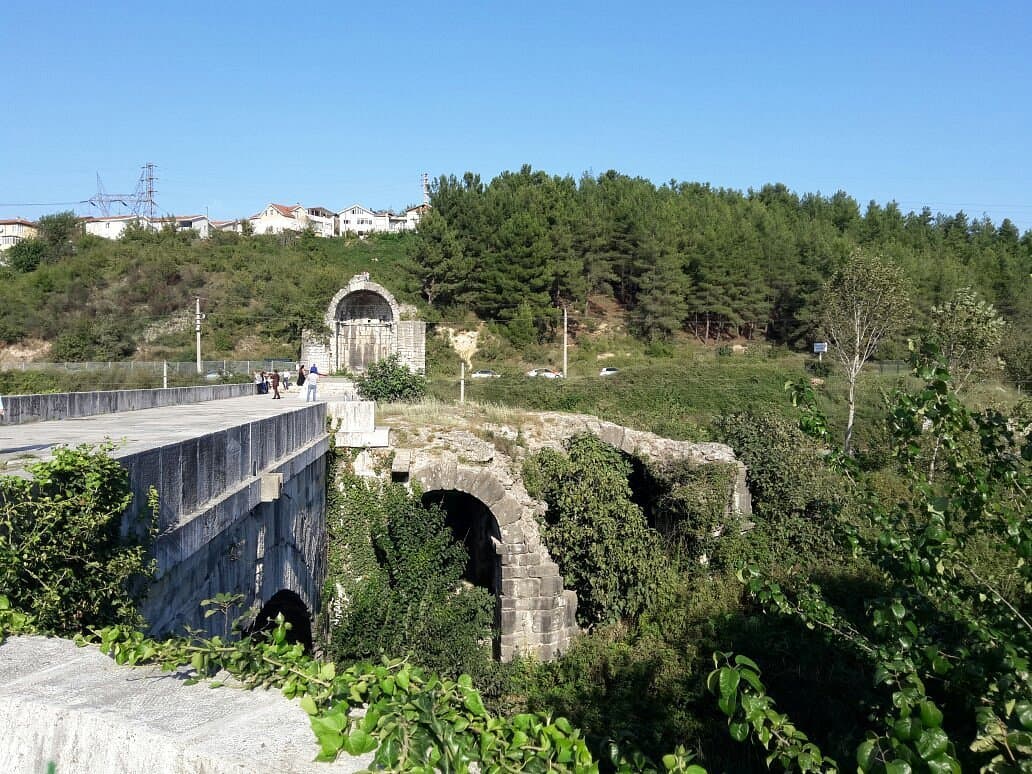
Bes Kopru, also known as the Justinian Bridge or Sakarya Bridge, is a monumental Roman structure dating back to the 6th century AD. Commissioned by Emperor Justinian, this bridge was a crucial part of the Silk Road and served to connect the two sides of the Sakarya River, facilitating military movements and trade. Its enduring presence for over 15 centuries stands as a testament to advanced Roman engineering and its strategic importance in the Byzantine Empire.
Visitors consistently praise the bridge's historical significance and its ability to transport them back to the Roman Empire era. Many reviewers highlight its impressive length, originally around 400-430 meters, and its robust construction. However, some parts of the bridge are currently undergoing restoration, and visitors note that one span has been significantly altered to accommodate a railway line. Despite these changes, the sheer age and scale of the structure leave a lasting impression.
For a meaningful visit, it's recommended to allocate about 30 minutes to an hour to explore the bridge and its surroundings. Several reviewers suggest reading about its historical context and original purpose before visiting to fully appreciate its importance. While there isn't a specific 'best time' of day mentioned, visiting during cooler weather might enhance the experience, especially given the bridge's length. Visitors should be aware that the area might be undergoing restoration, so expect some construction work or limited access to certain sections. There is a walking path on a neighboring field that offers alternative views.
Reaching Bes Kopru can be a bit challenging, as visitors describe the route as 'a little complicated.' It is located very close to the D-100 motorway and highway crossroads near Sakarya and Sapanca. Reviewers advise following historical signs on the road, as GPS navigation might be tricky due to the local name 'BESKOPRU' not always being clearly mapped. One visitor mentioned encountering a metal door at the end of the road, suggesting parking nearby and walking around to the right-hand side to access the site.
A common complaint is the current state of restoration and alterations, which can detract from the original grandeur. To mitigate this, visitors should manage expectations regarding pristine conditions and focus on the historical narrative rather than expecting a perfectly preserved ancient site. The presence of a railway line cutting through one span is also noted, which can be jarring for those expecting an untouched Roman ruin. Embrace the blend of ancient history and modern alterations as part of its ongoing story.