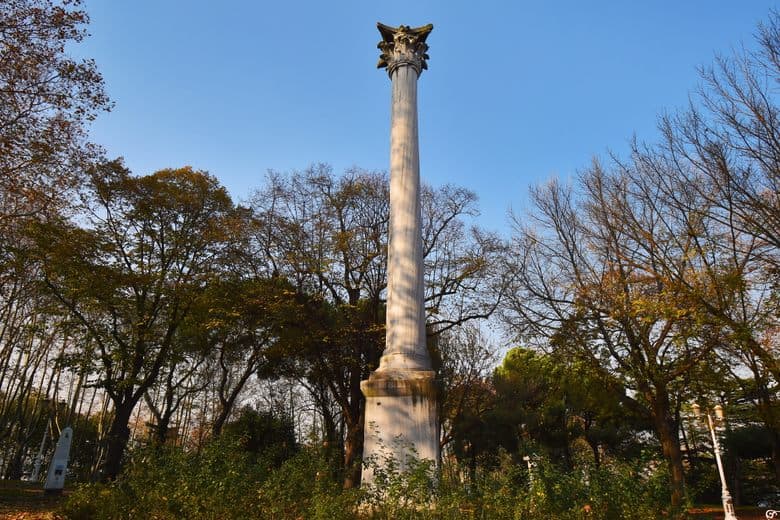
The Column of the Goths, or Gotlar Sütunu, is an ancient Roman monument situated in the outer courtyard of Topkapi Palace, on the edge of Sarayburnu, within Gülhane Park. Carved from a single block of Proconnesian marble, this column is believed to be one of Istanbul's oldest Roman structures, dating back to the late Imperial period (2nd or 3rd century). Its Latin inscription commemorates a Roman victory against the Goths, though the exact emperor it honors remains a subject of debate among historians.
Visitors often note that the column can be easily overlooked amidst the greenery and park benches of Gülhane Park. While it stands around 18.5 meters tall and is in remarkably good condition, its historical significance isn't immediately apparent without prior knowledge or reading the nearby informational sign. Those who take the time to appreciate its age and origin find it a fascinating, albeit subtle, piece of Istanbul's deep history. Reviewers suggest it offers a quiet moment of reflection away from the more crowded attractions.
To make the most of your visit, allocate about 15-30 minutes to locate and appreciate the column. It's best visited during daylight hours when Gülhane Park is open. There's no entry fee specifically for the column, as it's located within the free-to-access areas of Gülhane Park. Consider combining your visit with a stroll through the park or a trip to the nearby Topkapi Palace, as the column itself is a relatively quick stop.
The Column of the Goths is easily accessible. It stands on the northern edge of Gülhane Park, approximately a 15-minute walk from the Topkapi Palace entrance. Gülhane Park is well-served by public transport; the nearest tram stop is Gülhane (T1 line), which is just a few minutes' walk from the park entrance. From there, follow the paths towards the palace walls to find the column. It's also a pleasant walk from Sultanahmet Square.
A common complaint is that the column lacks prominent signage or context, leading many visitors to pass by without realizing its historical importance. To mitigate this, it's advisable to read up on its history beforehand or look for the informational plaque usually placed nearby. Without this context, it might appear as just another column in a park.