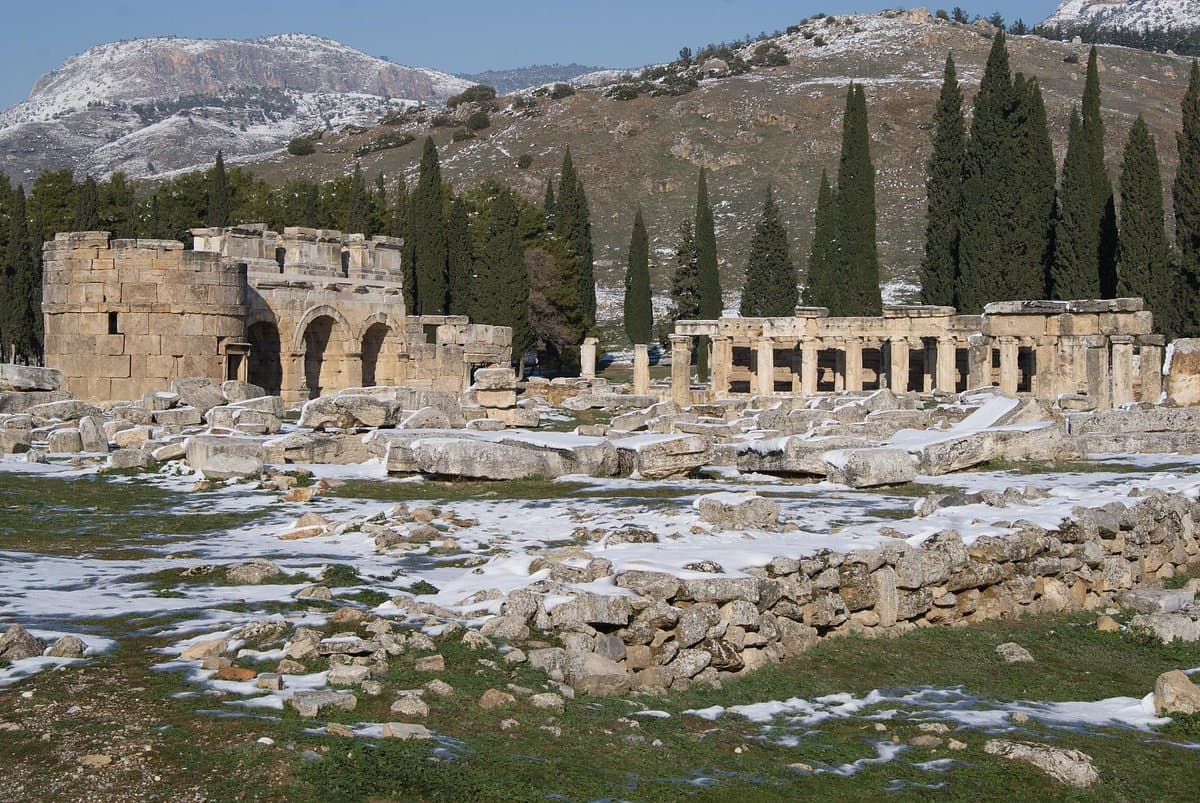
The Byzantine Church, located within the ancient city of Hierapolis, represents a significant early Christian structure built after Christianity became accepted in the Roman Empire. Its historical importance lies in its connection to the broader religious transformation of the region and its impressive scale, even in ruin. Visitors often reflect on the ingenuity of ancient engineers who constructed such massive buildings without modern tools.
Visitors consistently praise the church's impressive size and the historical context it provides within the Hierapolis site. Many are awestruck by the sheer effort and skill involved in its construction, with some describing it as "nothing short of amazing." Reviewers appreciate the interpretive signs near the ruins, which help contextualize the site's history. However, a common observation is the lack of extensive restoration, with only a few walls and arcades still standing. Some visitors, particularly those who have seen numerous Greco-Roman sites, find it less impactful compared to other, better-preserved ruins.
To make the most of your visit, allocate sufficient time for the entire Hierapolis site, as the church is just one part of a very large ancient city. Many visitors combine their trip with the Pamukkale travertines, often making it a day trip. It's advisable to wear comfortable walking shoes and bring water, especially during warmer months, as exploring the extensive ruins involves considerable walking. While the church itself might not warrant a dedicated long stop, spending 15-30 minutes here is usually sufficient to appreciate its scale and historical significance. The best time to visit is in the morning or late afternoon to avoid the midday heat and larger crowds.
The Byzantine Church is situated adjacent to and south of the Hierapolis Archaeology Museum, on the west side of the ruins. The Hierapolis site is easily accessible from Pamukkale. Many visitors walk up from the Pamukkale travertines, which can be a significant uphill trek. Alternatively, you can drive or take a taxi to the upper entrance of Hierapolis, which is closer to the museum and the church. Parking is available at the upper entrance. Once inside Hierapolis, the church is part of a network of ruins, and clear signage helps guide visitors.
A recurring complaint among some visitors is the limited restoration, which leaves much of the church as scattered ruins. While this can be disappointing for those expecting a more intact structure, it's important to approach the site with an appreciation for its archaeological value rather than expecting a fully reconstructed building. Reading up on the history of Hierapolis and early Christian architecture beforehand can enhance the experience, allowing visitors to better visualize its past glory despite its current state.