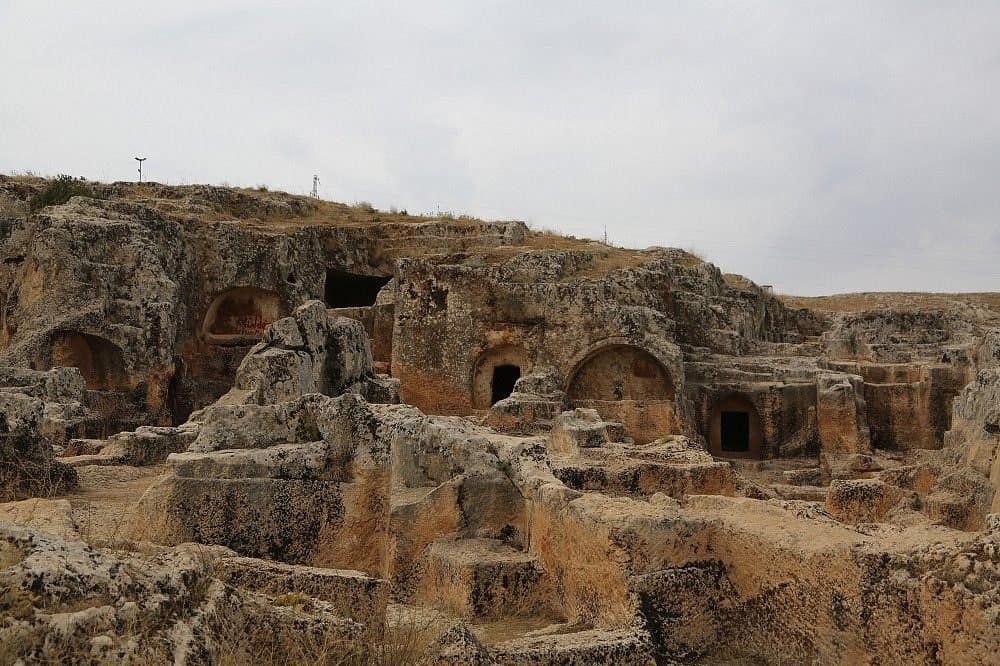
The Pirin Ruins, historically known as Perre, represent one of the five largest cities of the ancient Commagene Kingdom and later an important Roman center. Founded around the 3rd century BCE and abandoned by the 7th century CE, this extensive archaeological site is primarily known for its vast necropolis featuring nearly two hundred rock tombs and sarcophagi. It served as a crucial junction on ancient trade routes, connecting significant cities like Melitene (Malatya) and Samosata (Samsat).
Visitors consistently praise the site for its surprisingly large area and the well-preserved rock tombs, which are often easily accessible. Many reviewers highlight the informative signage throughout the site, making self-guided exploration straightforward. The presence of a visitor's center, which sometimes offers a 3D movie about the Commagene Civilization, is also frequently mentioned as a valuable addition to the experience. The site is generally not crowded, providing a peaceful environment for exploration, and a timber boardwalk facilitates movement across the extensive grounds.
To make the most of your visit, allocate about 1 to 2 hours for exploration. Visitors recommend bringing adequate heat protection and water, especially during warmer months, as the site is large and exposed. While some reviewers noted free entry, others mentioned a nominal fee, suggesting it's advisable to check current admission policies. The site is accessible year-round, but a visit during cooler months or early morning/late afternoon in summer would be more comfortable. If the visitor center is open, watching the 3D movie is highly recommended for a deeper understanding of the Commagene Kingdom.
The Pirin Ruins are conveniently located approximately 5 km from the city center of Adıyaman. Public transportation, specifically half buses, are available from the city center to reach the site. For those driving, the ruins are easily accessible by car, and parking is generally not an issue. The address is Orenli Mah. Golbasi Merkez, Golbasi, Adiyaman.
A common observation among visitors is that while the site is extensive, not all areas have undergone significant excavation. This means some parts may appear less developed than others. However, this also offers a sense of discovery, allowing visitors to imagine the scale of the ancient settlement. While signage is generally good, some reviewers mentioned that the site itself could be better signposted from the main roads leading to it. It's advisable to use a navigation app or ask locals for directions to ensure a smooth arrival.